Beta access
The public status is controlled from the administration: closed beta, open beta, or release. During closed beta, account creation is limited to invited email addresses; open beta and release allow public registration under the existing rate limits, email controls and Turnstile anti-bot verification when enabled. The token is always validated server-side for the expected registration action and domain. An emergency switch can close every registration regardless of status.
A visitor can request an invitation without creating an account. The request expires and may be declined in the administration; accepting it immediately creates or refreshes the invitation and queues its email in the same action. An invitation can expire or be revoked and is marked as accepted when the account is created. The public response remains intentionally generic so it never reveals whether an account exists.
Every account must then verify its email address before entering the game. The link expires and can be resent from the verification screen. From the login page, “Forgot your password?” requests a reset link that remains valid for 60 minutes; the response stays identical whether or not the address belongs to an account. Changing the password closes the account’s active sessions.
An account can be suspended until a set date or banned by the administration. Its sessions are closed immediately and new sign-ins are refused until the suspension ends or an administrator reactivates it. After valid credentials are provided, the sign-in screen clearly states the restriction and, for a temporary suspension, its end date.
Account deletion is handled through anonymization: identity data is replaced, while bastions, reports, contracts and events required by the shared world history remain consistent.
The permanent Sovereign
On the Sovereign profile, the Doctrine panel shows the bonus applied in the current world after caps, specifying its effect on base attack, defense or production. This value comes from your participation in that world.
Doctrine cards specify the base affected by each bonus: your units’ attack for the Conqueror, your units’ defense for the Guardian and your buildings’ production for the Builder. Numerical examples use the selected world’s values.
When joining a world with doctrines, a Sovereign step appears between region selection and the final summary. Choose your name, portrait and doctrine without leaving the arrival flow. Explicit confirmation saves the permanent doctrine; an error preserves your world, people and region choices. An already configured Sovereign is retained and this step is skipped automatically. Worlds without doctrines keep their usual arrival flow.
In the “Active bastion” block, the portrait, name and doctrine open the Sovereign profile within the game, keeping the menu and resources visible. Its chronicle presents participations by season. “Customize my Sovereign” opens the editing dialog; saving returns to this profile. The card separates the Sovereign and bastion, with an Empire button for managing multiple bastions and a link to the season stage. On mobile and tablet, the portrait, bastion name and doctrine share a compact header above the resources. An announcement introduces the feature to players without a doctrine and can be dismissed to set it up later. When open worlds are upgraded, games, possessions and queues continue. The Infirmary and Tavern appear at level zero with no free construction or Heroes; their usual requirements, costs and times apply, and the Tavern remains capital-only. A confirmed doctrine starts immediately in these participations, initially at +5%, without boosting earlier production. Missions already underway retain the effects available at departure. A previously chosen doctrine starts at the upgrade. Closed worlds and their archives remain unchanged.
Every verified account can create a Sovereign from “My Sovereign” in the world lobby or account. This identity stays the same across games, including before joining a first world and after archiving. Creation is optional and does not change the player name.
Names contain 2 to 40 characters and start with a letter. Accented letters, numbers, spaces, apostrophes and hyphens are accepted. Several accounts may choose the same name. The catalogue includes eight free portraits and eight Premium portraits, independent of the chosen people; image uploads are not available. It includes blonde women and men. Names and available portraits can be changed for free, and changes are logged. Moderators can correct them and lock editing, recording a reason in the private moderation history.
Choosing a Premium portrait requires active Premium access for its owner, checked by the server. On expiry or revocation, a replacement free portrait is shown to everyone; the Premium choice stays saved and returns when access is reactivated. The owner can still edit their name or replace the choice with a free portrait. A border and check mark indicate the choice in the picker, which remains keyboard accessible.
The chronicle gathers participations, final ranks, badges and honours. Collective honours follow alliance membership at the time of the award. Other signed-in players see only published, archived seasons, never ongoing participations, internal worlds, hidden archives or moderation history.
After creating the identity, the player may separately confirm a permanent account doctrine: Conqueror, Guardian or Builder. It has no levels, experience or progression; Premium grants neither a change nor a reset. The Sovereign itself takes part in no mission. The identity stays optional in worlds without doctrines, but a confirmed doctrine is required before joining a compatible world.
Initial values are +5% for all three doctrines. Conqueror adds 5% of the owner’s units’ base attack when initiating combat, including combat expeditions; it changes neither cargo, speed, loot nor espionage. Guardian adds 5% of the owner’s units’ base defense on the defending side, including reinforcements at an ally, without improving other contingents or fixed defenses. Builder adds 5% of producing buildings’ base production before world speed; outposts, rewards, loot, cargo, deliveries and refunds are excluded.
The manual simulator accepts effective Conqueror and Guardian bonuses after caps. They are optional and preserved in saved scenarios. Guardian applies to the entire entered defending composition: reinforcements with different owners require separate comparisons. Report imports include the known offensive bonus; the defensive bonus must be checked manually.
New worlds are configured before registration is announced and retain their rules. Introducing the module into already open worlds is a one-time transition that preserves previous rules; it does not allow unrestricted mid-season balancing. Each participation preserves its doctrine and coefficients, followed by its archive. NPCs receive a deterministic doctrine with the same values and caps.
Compatible module sources add up before an initial cap of 15% per domain, configurable before announcement between 0 and 25%, like doctrine coefficients. They never multiply each other: +5% and +8% give +13%, not +13.4%. This supplement adds to the existing calculation without multiplying people, research or alliance bonuses; unit defense then benefits from walls under the usual rules. The additional total is rounded down. Sources and caps are visible before commitment and in reports; offensive effects are preserved at departure. This stage adds no levels, equipment or Heroes.
Creation, names, the eight free portraits and doctrine selection do not require Premium. Changing to an available portrait consumes no resources or Obols. Seasonal Heroes, the Tavern and the Infirmary depend on world rules and are described in the buildings guide.
The Sovereign’s season memories
At the next world closure, the Sovereign chronicle will preserve a self-contained summary: the world doctrine and coefficient, founding capital when recorded, final capital, Tavern and Infirmary levels, Heroes, roles and rarities. Previous closures are not reconstructed and an unknown founding capital is labelled accordingly. Capital transfer remains reserved for a separate stage.
Owners can review totals for examined losses, admissions, treatment and recovery, together with the six latest events in each category for each Hero. Paid costs and refunds for retained treatments remain visible. Heroes are shown twelve per page; unfinished or cancelled recruitment retains its status and does not count as a recruited Hero.
Visitors may view historical identities and the public summary of an archived, published season, never detailed assignments or treatment. Internal, hidden and ongoing seasons and anonymized accounts are excluded from public access. Administrators can inspect summaries in read-only mode.
These frozen memories remain readable if definitions or active Heroes disappear. They provide no advantage in another world and cannot recruit a former Hero, treat anyone or restart a mission. The epilogue already blocks new actions; archiving then preserves closing states without replaying them.
Relocating the capital
From the bastion services, open the Tavern and select the Capital relocation button. A second dialog lets you choose the destination, preview the relocation and confirm it. Closing it returns to the Tavern without changing the bastion being viewed.
A future world can separately enable capital relocation, with rules frozen before registrations and opening. The baseline is at least 48 h, a 14-day cooldown after each success, two successful relocations per season and Keep level 3 at the destination. World speed does not accelerate these strategic timers. The physical Tavern and Hero journey can extend the minimum duration.
The destination pays 4,000 food, 6,000 dark wood, 3,000 iron and 1,000 essence at departure. The preview shows both bastions, duration, costs and roster before confirmation. Costs are consumed without cancellation or refund, even on failure. Duplicate submissions cannot pay or relocate twice.
Both bastions must belong to the same active participation, with a unique capital. Vacation and Finale block relocation, which must be able to arrive before the Finale starts. A raid already heading to either bastion blocks departure. Raids launched afterwards remain possible and do not cancel relocation. Only one operation can be active at a time.
No recruitment or Tavern construction may be active. All Heroes must be available, healed and back at the capital. They become unavailable during relocation. The Tavern temporarily closes, retains its level and moves with the roster. Personal offers keep their normal calendar without a free cycle or extra refresh.
Stocks, troops, ordinary buildings, queues and Infirmaries stay in their bastion. The selected bastion does not change. The founding capital remains immutable. At the deadline, the server checks ownership, institutions, timing and Heroes again before switching both seats atomically. A technical delay does not invalidate an arrival scheduled before the Finale, provided the other conditions still hold.
If the destination is lost, the roster must finish its return journey before becoming available; the capital and Tavern retain their former seat. World closure interrupts relocation before archiving. An exceptional loss of the home bastion requires administrative correction without teleporting Heroes elsewhere. History and a report explain success or failure. Successful relocations join seasonal memories, including intermediate capitals; preparations and the roster remain private.
Permanent account and seasonal worlds
The people chosen in the current world appears below the active bastion name and in the mobile header. Click its name to view its strengths and trade-off without leaving the page. This panel reflects the current participation and does not allow changing people during the season.
The account and player identity are permanent: credentials, access rights, Premium, cosmetic preferences, distinctions and compatible history stay attached to the player. Each world instead has its own competitive participation with its bastions, resources, buildings, units, research, territories, objectives, alliance, reputation and ranking. Progress earned in one world therefore grants no power advantage in another.
Every world has a French name and an English name. The Lobby, game, public pages, emails, and archives automatically display the name matching the player’s chosen language, while its technical identifier remains unchanged. A Latin or language-neutral name can simply be entered identically in both languages.
When the first bastion is created, a welcome report summarizes this seasonal cycle and provides direct access to the season calendar, wiki and updates. These resources are also grouped with account management under Settings.
Every detailed report carries an illustrated banner for its family: system, progression, intelligence, offense, defense, territory, logistics, protection, or alliance and Ash. This visual identity helps players recognize its nature without replacing its title or text label; only major events, such as entering a season, may receive their own illustration. A new report is written in the language currently saved on its recipient’s account, including when an action completes automatically in the background.
A world moves through four phases: preparation, open, epilogue and archived. Only the open phase accepts progression and game actions. During epilogue or after archiving, the map, reports, ranking and chronicles remain available to browse, while production, queues, missions and automatic resolutions are frozen.
Within its open period, a seasonal world follows four distinct stages: settlement, regional expansion, fronts and conflicts, then the finale. Each world defines its calendar and stage durations and keeps them in its rules snapshot. This seasonal clock does not by itself enable a mechanic that is not configured for that world.
During settlement, progression remains local. Travel through regional passages opens with expansion. Passage conquest and Ash Front operations begin during the conflicts phase. Heart of Ash mechanics remain reserved for the finale. A locked action names its required phase, and the seasonal schedule is available from the world interface.
Twenty-four hours before regional expansion, fronts and conflicts, and then the finale open, every human player whose participation in the world remains active receives a role-play email in their saved account language. Each announcement recalls the scheduled time and what the new stage makes available. NPCs and internal sandbox worlds do not receive these messages.
Players can retain access to older games and switch between worlds in which they participate. Returning to an archive restores that world’s exact context without replacing the permanent account identity or mixing its data with the active season.
The Lobby catalog separates worlds to join, active participations, and archives. It shows their age, human population, speeds, seasonal stage, Atlas size, registration window, and capacity. NPCs count toward neither the public population nor human capacity.
Administrators can remove an archive from the Lobby when it should no longer clutter the catalog. This setting hides only its Lobby card: it deletes neither the world, its participations, nor its preserved reports and snapshots.
The Lobby is now the gateway to this catalog. After verifying their address, a new account chooses its first world there; an existing player can join a new season, resume a participation, or browse an archive. Settings > Worlds keeps the game and archive history plus a Lobby button, without offering a new start. A frozen-world banner also provides a way back.
A new start is allowed only in an open world with registration enabled, within its registration window, below its human capacity, and with an available starting region. The server always enforces these conditions; an internal world is never offered as a new destination.
Joining a world follows four steps: world, people, starting region, then confirmation. Choices form a draft that resumes after signing back in, with back and cancel actions available. When only one world is actually available, it is selected automatically. Every new participation chooses between the Ember Clans, Ash Guilds, and Free Marches.
At the starting-region step, each option displays a miniature of the geography actually generated for that season. This preview contains terrain only: players, bastions, available positions, resources, structures, ownership, strategic passages, and movements remain hidden.
Only ordinary regions explicitly opened to new starts are offered. Each has an admin-managed human capacity and recommendation weight. NPCs use no place: recommendation compares weighted human occupancy only, and a full region disappears from both selection and the world catalog.
Before a world opens, an admin-managed process generates its regions and maps, reserves and validates player positions, then places three NPCs in every starting region, one for each people. Each instance receives a distinct regional identity and bastion name while retaining its faction doctrine. Every such position remains in the main passable component and avoids resources, passages, landmarks and other starts. Two starts remain strictly more than seven tiles apart, meaning at least eight tiles, while NPCs occupy three distinct sectors and remain at least eighteen tiles apart. Every player position retains at least two reachable NPCs within a reasonable regional distance and at least one exploitable resource inside its initial territorial range. At every registration, unassigned reservations are checked again against all current territorial influence, including NPC bastions, towers and outposts; any reservation now covered is regenerated elsewhere. Repairing a legacy world adopts existing NPCs into their regional people instead of duplicating them and preserves their progression. It also recovers recognizable legacy profiles whose key is missing, replaces their technical neutral reservations without conflicts, and recreates any missing player positions without reusing an existing identifier. Existing human bastions are never moved to satisfy a newer starting rule; only unassigned reservations are regenerated and, when a legacy map can no longer fit its configured capacity, that capacity is adjusted to the number of valid starts retained. The official seasonal ranking compares players only; NPCs remain available in a separate regional-forces ranking. The world cannot open until these checks succeed.
Your people is an immutable seasonal choice. Ember Clans raid 10% faster and carry 15% more raid loot, but construct 6% more slowly. Ash Guilds construct 10% faster and produce 8% more resources, but their raids are 8% slower. Free Marches, recommended for newcomers, construct and raid 3% faster with 2% more production, at the cost of 5% less raid cargo.
No participation or bastion exists before final confirmation. At that point, the server locks the world, checks its window and capacity again, reserves a free position in the selected region, then creates the participation, bastion, resources, buildings, units, protection, and welcome report together. A repeated submission therefore cannot create a second start.
Every new official season starts from a map generated with a new random seed. Regions, terrain, resources, passages, starting positions, and finale elements are generated and validated before opening. The single administrative creation form also sets landmark activation, enabled families, and any seasonal objective; current technical versions and regional quotas are applied automatically before generation. During administrative creation, a window automatically follows every step through validation and can then open the world directly, with an explicit choice over registrations. The approved map and rules are then frozen: no automatic regeneration can change the geography or enable a competitive module late in an announced or open season.
Administrators can nevertheless expand a world in preparation or already open up to six standard regions. The process adds only the new maps, their player starts, nearby resources, three NPC forces, and Atlas passages, then validates them before making them available. Existing regions, bastions, positions, and NPCs are neither regenerated nor moved.
For Chronicle Zero, the cosmetic Founder badge requires at least 14 distinct active days during the season. A day counts from the first successful meaningful game action, such as building, researching, training, launching a mission, acting on the map, trading, or contributing to an alliance action. Signing in, navigating, refreshing, reading or sending messages, changing a preference, or cancelling an action is not enough. Multiple actions on the same day still count as one active day.
The initial 3 + 5 + 5 + 3-week split remains configurable. Chronicle Zero is an invitation-only closed beta: preparation, announcement, and opening are three separate approvals, and saving a date never opens the world or sends invitations automatically.
Power and ranking
Ranking power adds 100 points per building level, 10 points per owned unit, 250 points per research level, and 1 point per Honor point.
Every unit in the world remains counted: inside bastions, on missions or transfers, travelling toward a territorial action, and stationed in tower, outpost, passage, or anchor garrisons. Combat losses reduce power; moving or stationing survivors does not.
Rankings are recalculated every fifteen minutes. The displayed value may therefore wait for the next recalculation after construction, research, training, an Honor gain, or military losses.
Player rankings show each player’s current alliance. A separate tab ranks alliances by the combined power of their members and also compares average power, member count, and Ash Seals without mixing those values into the individual ranking.
Formula: (building levels × 100) + (owned units × 10) + (research levels × 250) + Honor.
Ash Seals and alliance progress
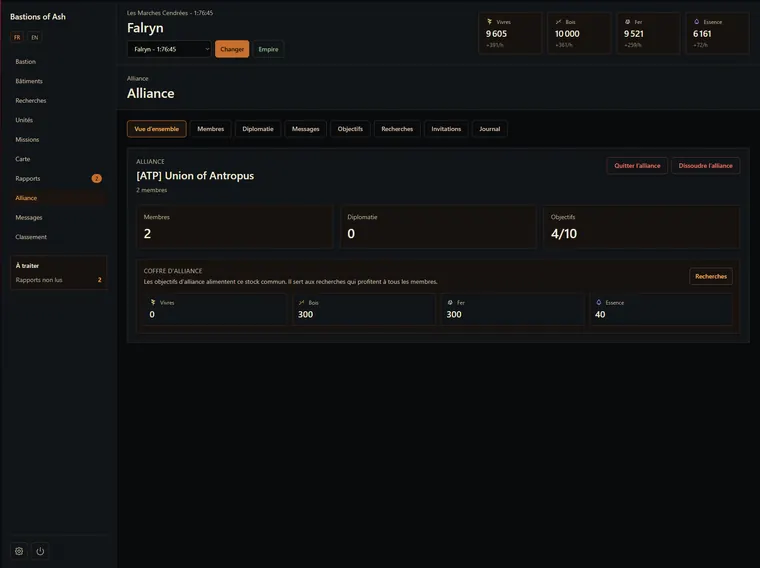
Ash Seals measure an alliance’s lasting seasonal achievements. They are added to its total, cannot be spent or transferred, and remain visible in an immutable ledger.
An alliance can currently earn Seals by completing an alliance objective, capturing each regional passage for the first time, and reaching milestones on an Ash Front. Award amounts and the whole system can be managed by administrators.
Every source has a unique key: repeating an objective, recapturing an already rewarded passage, or restarting an operation on the same front cannot create the same reward twice. When a player directly triggers the achievement, their name is preserved as contributor; other gains remain collective.
Ash Seals represent shared alliance progress. Individual attribution preserved in the ledger is historical and grants no personal power bonus.
How to read this wiki
The wiki is meant to be a gameplay guide as much as a reference. The opening chapters explain intent and common situations; the cards and tables that follow provide exact values read from the server.
When a rule depends on an admin setting, the page explains the general logic first, then exposes the active values. You can understand the game without memorizing every technical key.
Following updates
Every player-visible change prepares a French and English fragment in the project. After a successful deployment, all new fragments are assembled into one draft and grouped as features, improvements, balance changes, fixes and known issues.
The draft stays hidden and editable in the administration area. Only an administrator can approve it and then publish it manually and immediately; no deployment, schedule or automation can make it public.
In the game, a badge highlights visible notes published since the account was created that have not been opened yet, so a new player starts with a count of zero. Opening a note marks it as read for the signed-in player, and the page can mark every update as read in one action; visitors can also read notes intended for the public.
The public site also provides permanent pages for worlds, their archives, guides and chronicles. Every page has a stable French and English address so it can be shared and found without depending on a language stored in a session. On a first visit, a visitor without a saved preference is welcomed in the supported language preferred by their browser; when no language matches, the site uses English. Their explicit FR or EN choice is then remembered.
Every publication is signed “Equipe de Bastions of Ash” and can link directly to the wiki chapter that explains the affected rule.
The server remains the source of truth
Wiki text describes player-facing rules. When in doubt, server validation always wins: range, cost, travel time, capacity, diplomacy and the real map state are recalculated when an action is taken.
Each action respects the world state of the targeted bastion and its participation’s vacation mode, even from an old open page. A disabled building, research or unit definition can no longer start a new queue.
Automatic catch-up continues to check overdue actions and missing reports. Units join their bastion at their own deadline.
An interruption to realtime notifications does not undo an operation already recorded. Its result and report remain available; delivery of the new-report signal is retried separately.
Whichever game page is open, a unit, construction, research, or mission deadline triggers server resolution and its report when applicable. Only the affected areas are then updated. Each trained unit still joins the bastion at its own deadline, without waiting for the full batch. The full page does not reload, preserving in-progress input, open windows, and reading position. On the map, a closed Target panel stays closed, the selected route remains visible, and an open action modal with its composition is not replaced by an automatic refresh. After a map action is successfully submitted, however, its window closes and the panel is updated immediately.
- Building, research and unit definitions come from the database.
- Active settings reflect the current admin-managed world values.
- Narrative chapters explain why those values matter in play.